
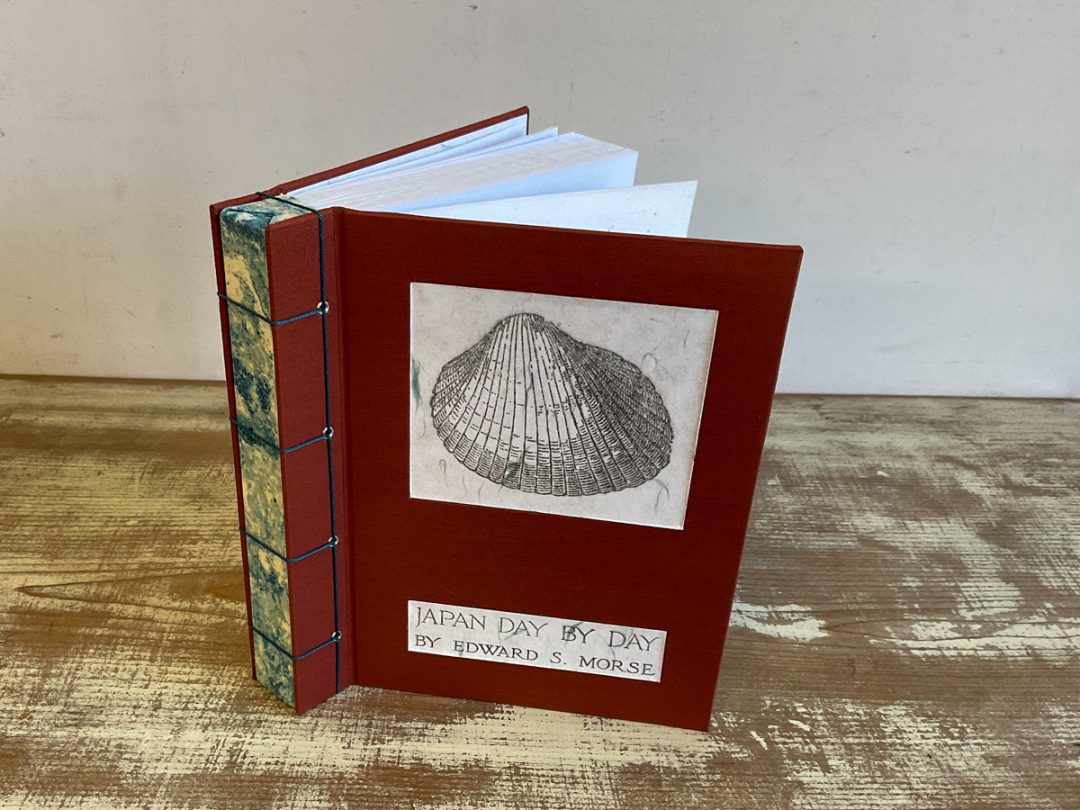


size:182mm×154mm×35mm 443ページ
<作品の説明>
This work was inspired by a figure from my hometown, named Edward Morse, whose existence was completely unknown to me until I came to Japan. In my home city of Portland, Maine, there’s an old red Japanese postbox with a plaque that reads “To the city of Portland from its sister city Shinagawa, Japan, October 1989.” It’s an object that I would walk by almost every day growing up, and in my imagination, I always thought there must be an equivalent American mailbox (the square blue kind with an eagle logo) somewhere in Shinagawa. When I set out to find this memento in the Omori Shell Mounds Garden, however, I was instead met with a statue of a bearded man inspecting what looked to be an oddly-shaped vase. This man was Edward Morse, and upon reading the various displays and related monuments around the park, I learned that he was a Victorian zoologist who discovered the Omori shell mounds, named the J?mon period and is generally considered to be the “Father of Japanese archeology.” Portland is a small city, so I was completely blown away by this revelation; in all of my years of schooling there, I had never once heard of Morse or his contributions to science.
Through printing and binding the first volume of his 1917 book Japan Day by Day, I hope to in my own small way push against Morse’s unjustified anonymity back home. In the end, I chose a stab-bound Japanese aesthetic, with visible thread along the spine, but retained the Western layout to reflect the text’s cultural duality. The materials used are greyboard, bookcloth, washi, copy paper, mull, thread, grommets, glue and wintergreen oil.
<エピソード、制作時の事等>
I have had the rough idea for this book for some time, but I originally wanted to create the front and back covers from hand-made ceramic tiles to reflect the J?mon pottery shards discovered by Morse. The tiles were to be bound together using a Coptic stitch, but neither my pottery nor stitching skills are developed enough yet to pull it off. As such, I had to alter my idea to bring it in line with processes that I better understood. This “simplification,” however, created its own challenges as the design I settled on wasn’t a single technique, but rather an amalgamation of techniques. By far my greatest difficulty was trimming the text block without access to a guillotine. After many failed attempts and rapidly shrinking margins, I decided to try a kanna plane out of desperation. The plane worked to square the block but the cut wasn’t as clean as I had hoped for.
<自己紹介>
My name is Johnathan and I’m currently working as an Art teacher here in Tokyo. I am very much an amateur when it comes to bookbinding, but I do have a background in the adjacent field of printmaking, so certain peripheral materials and techniques are familiar to me. While every new book inevitably presents unforeseen challenges to surmount, I am nevertheless enjoying the process-oriented nature of the craft as I slowly improve my skills.
和綴じと洋風の表紙、背が布でくるんであったのが印象的でした